A reservation tells a property who is expected, when they arrive and which room or room category they booked. Running a stay can also involve arranging a transfer, following up a repair, coordinating a room change or passing a guest request between shifts. A property needs a reliable owner for those actions and a way to see whether they happened.
Start by looking at what the existing property management system already offers. Some products cover more than bookings. Oracle OPERA Cloud, for example, supports service requests and service recovery follow-up where those features are configured. A hotel can often improve the process by setting up a feature it already has and giving the team a consistent way to use it. Oracle OPERA Cloud front desk controls
Follow one guest request across shifts
Imagine a late arrival who asks for a room change and a transfer from the station. Front desk checks the reservation and sees which room changes are possible. Another team confirms whether it can arrange the transfer. The night shift needs the decision, the deadline, who owns the next action and what the guest has already been told.
A short handoff record can carry that information. It needs a link to the reservation, an assigned owner and a due time. It should also show whether anyone has confirmed the request and when the guest was last updated. Keep sensitive notes in the system and access group that already own them. Most task notifications can use a reference and an action without repeating guest details.
Make ownership survive the shift change
In this illustrative example, the day shift receives the transfer request at 19:10 and owns the guest update due at 20:00. The transport team can confirm availability but front desk remains responsible for telling the guest. The next shift starts at 19:45.
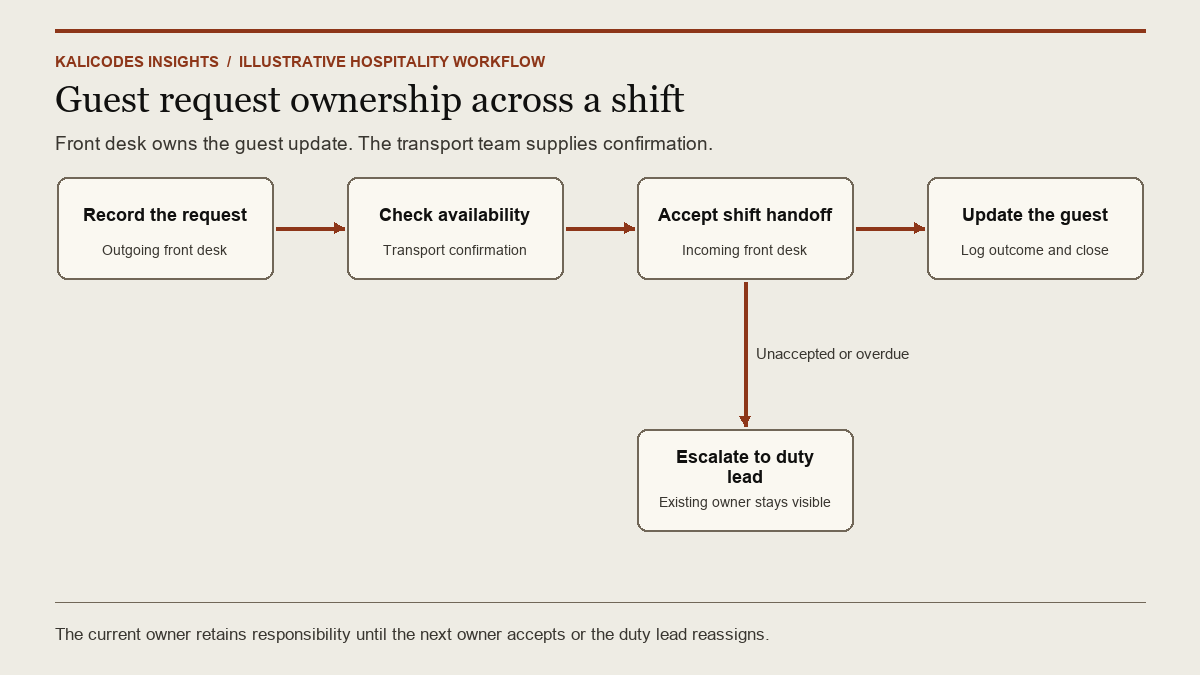
| Time or trigger | Record and action | Owner after the step |
|---|---|---|
| 19:10, received | Link the reservation reference, record the task and set a 20:00 update deadline. | Outgoing front desk |
| 19:30, awaiting confirmation | Store the last guest update and the transport response needed. | Outgoing front desk |
| 19:45, shift overlap | Incoming front desk acknowledges the handoff. Record the new owner and acknowledgement time. | Incoming front desk after acknowledgement |
| Handoff unaccepted or update overdue | Put the item in the duty lead's queue, with the current owner visible. | Current owner until duty lead reassigns |
| Confirmed or alternative agreed | Update the guest. Record confirmation or the agreed alternative, then close. | Current front desk owner |
A team can use this acknowledgement rule even if it currently works from a shared task list. One visible owner remains responsible until the next person accepts. A late arrival that changes the request reopens the action with a new due time. Use the shift handover card
Choose the smallest change that closes the gap
| Where work gets stuck | Start here |
|---|---|
| Staff lack a consistent place to record an action | Configure the relevant task or trace feature in the current system and train the team on one example. |
| The action crosses systems and people copy the same fields | Test a connection using documented interfaces. Keep the reservation with the property management system. |
| Several teams need a shared, permissioned view with deadlines and exceptions | Pilot a small operations layer for that one workflow. Give each record and status a clear owner. |
Choose status names staff can act on. “Awaiting housekeeping confirmation” gives the next shift more information than “pending.” If an arrival changes, have one person or a clear rule recheck dependent tasks. Decide whether an overdue item should escalate or wait for a supervisor to review it.
Check the workflow on a real shift pattern
Walk through a normal request and a failed handoff with the people who handle them. Include the person covering nights or weekends, and check what they can see on the device they actually use. Confirm which fields can move between systems and how a temporary outage affects the handoff.
For a pilot, count overdue actions, requests with no owner, and cases where staff ask the guest to repeat information. Review the results with the team before adding another process. That keeps the project focused on a part of service the property can observe and improve.
If a property already has a dependable reservation system, a focused change to a handoff may be the most useful project. Start with the task that regularly gets chased between shifts. Explore Business Systems · Discuss an operations workflow
Practical resource
Guest request shift handover card
Use this card during an overlap between shifts. Keep the booking system as the source of truth and record only the reference needed for the handoff.
Worked example · hypothetical
In the hypothetical transfer request, day front desk receives it at 19:10. At the 19:45 handover, the incoming owner accepts it and keeps the 20:00 update due time.
Reference notes
Use a reservation reference. Keep guest details where the property has approved access and retention. The task card should carry only the information the receiving team needs.
| Field | Example |
|---|---|
| Task reference | Transfer confirmation, request T-017 |
| Reservation link | Internal property system reference |
| Status | Awaiting transport confirmation |
| Current owner | Outgoing front desk |
| Next action and due time | Confirm availability and update guest by 20:00 |
| Last guest update | Request received at 19:10 |
| Incoming owner and acknowledgement | Incoming front desk at 19:45 |
| Escalation | Duty lead if unaccepted at shift overlap or overdue |
| Completion | Confirmation or agreed alternative communicated |
The existing owner retains responsibility until another person acknowledges it or the duty lead reassigns it. Reopen the task with a new due time if arrival details change and affect the action.
Blank worksheet
Fill in a copy in this browser or print a blank sheet. Entries stay on this page. Use business references in the notes.
| Prompt | Your notes |
|---|---|